I received the Excellent Undergraduate Thesis Advisor, Excellent Class Advisor, and Excellent Lecturer awards from Beijing Jiaotong University.
Lingkun Li 李令昆
Associate Professor and Doctoral Supervisor
School of Software Engineering, Beijing Jiaotong University
I study mobile systems for sensing, localization, and on-device AI. My work uses ambient light, wireless signals, and off-the-shelf hardware to build and evaluate systems in real-world environments.
I received my Ph.D. from Michigan State University, my M.Eng. from Tsinghua University, and my B.Eng. from Beijing Jiaotong University. More about me.
Email 2027 Ph.D. Admission Curriculum Vitae Google Scholar BJTU Profile 中文博客

Recent News
News archiveOur paper on mobile LLM inference was accepted by ACM SIGMETRICS 2027.
I plan to recruit one Ph.D. student in mobile intelligent computing for 2027 entry. Details.
LayoutBridge was accepted to NeurIPS 2026, and DSETA appeared at KDD 2026.
Research
Visible-Light Sensing and Communication
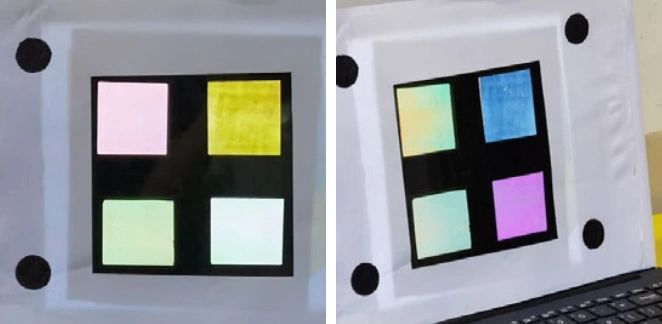
RainbowLight locates a phone using angle-dependent colors from passive tags. It achieved a mean 3D error of 9.6 cm in lights-on tests. LiTag uses the same effect to estimate pose. LuminaLink uses it for position-dependent communication, with a mean bit error rate of 3.0% at the intended position and 52.4% elsewhere in a 28-position test.
Localization and Spatial Intelligence
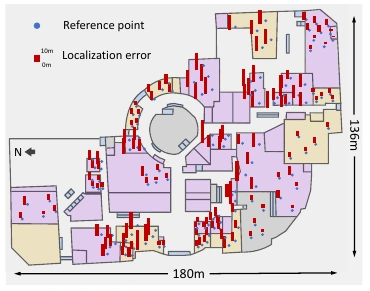
TransparentLoc uses cellular fingerprints from outdoor trips to recommend ride-hailing pickup points where GPS and Wi-Fi are unavailable. Our two-year DiDi study, described in the TMC extension, covered 50 million orders. In a follow-up study, we used outdoor Wi-Fi fingerprints for indoor localization and reduced median pickup error by 4.35 m compared with Lab2Wild in a shopping-mall experiment.
Intelligent Transportation
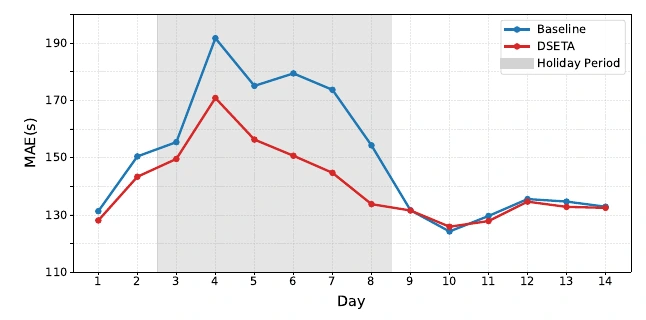
DSETA updates travel-time predictions at two timescales so the model can respond to incidents and holidays while retaining long-term traffic patterns. In an online A/B test on DiDi, mean absolute error fell by 6.62% in Beijing, 0.73% in Wuhan, and 2.40% in Xi’an.
Edge AI and Networked Systems
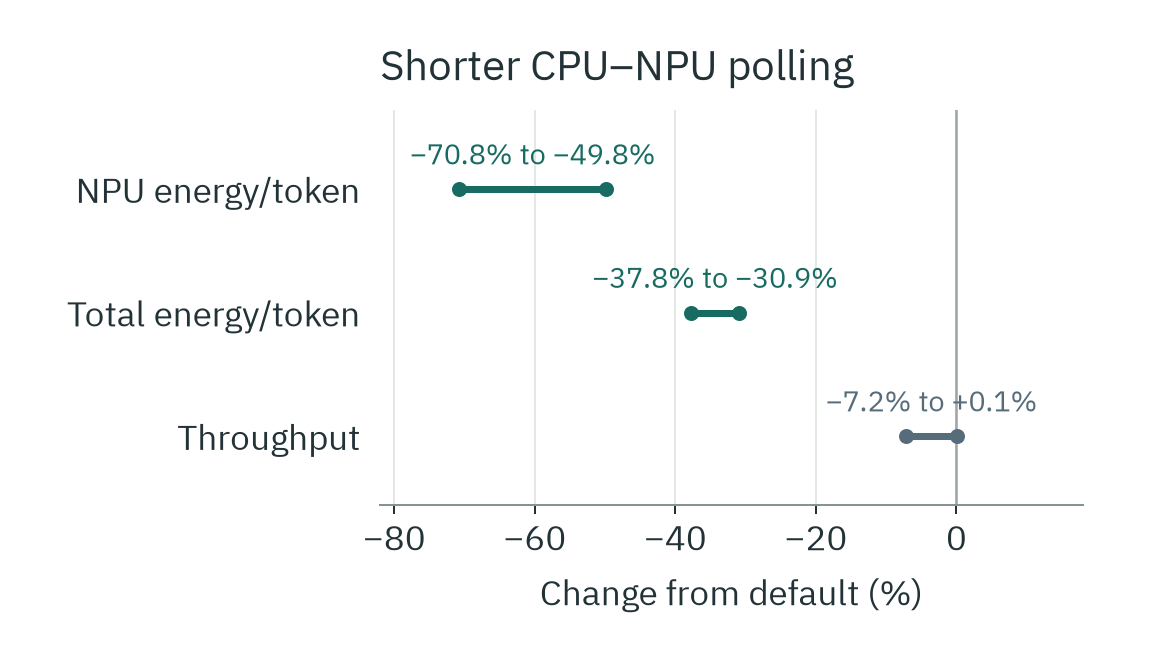
We built PowerBench to measure where energy goes during mobile LLM inference. Shorter CPU–NPU polling intervals cut total energy per token by 30.9–37.8% in our experiments. Most of the savings were on the NPU, consistent with it spending less time active after completing a request.
Prospective Ph.D. Students
I plan to recruit one Ph.D. student in mobile intelligent computing for 2027 entry through BJTU’s application and assessment process. Please send your CV to [email protected]. Applicants should be self-motivated and have strong English and programming skills. Programming skills will be assessed during selection.
For an example of this work, see our study of LLM inference on phones, where we measure energy use on each processor and test how CPU–NPU coordination affects it.
计划招收 2027 年入学的移动智能计算方向博士生 1 名,采用申请考核制。请将个人简历发送至 [email protected],遴选安排将统一通过邮件通知。北交大教师主页招生信息
Teaching and Mentoring
In Discrete Mathematics, students write proofs in Coq and submit them through an online lab for immediate feedback. See the teaching paper and the full course list.
I advise undergraduate theses and student projects. A team I advised won first prize in the North China regional round of the 2024 National College Student Software Innovation Competition. BJTU recognized me as an Excellent Undergraduate Thesis Advisor in 2025 and 2026. I also received the Excellent Class Advisor and Excellent Lecturer awards in 2026.
Selected Publications
Full publication listMobiCom 2018
RainbowLight: Towards Low Cost Ambient Light Positioning with Mobile Phones
Lingkun Li, Pengjin Xie, and Jiliang Wang. · PDF
INFOCOM 2025
LuminaLink: Enabling Low Cost Secure Visible Light Communication with Birefringence
Ruxin Lin, Bingyan Liu, Yelin Cui, Duo Liu, Ruipeng Gao, Xiaoqiang Zhu, Jiqiang Liu, and Lingkun Li (corresponding author). · PDF
MobiCom 2023
Experience: Large-scale Cellular Localization for Pickup Position Recommendation at Black-hole
Shuli Zhu, Lingkun Li, Xuyu Wang, et al. · PDF · TMC 2024 extension (corresponding author)
UbiComp 2025
Large-Scale Indoor Localization via Outdoor Crowdsourcing Trajectories on Ride-Hailing Platform
Shuli Zhu, Lingkun Li (joint first author), Xuyu Wang, Qiang Ni, Yuqin Jiang, Hui Gao, Zhaobing Han, and Ruipeng Gao. · PDF
SIGMETRICS 2027
Is Your NPU Ready for LLMs? Dissecting the Hidden Efficiency Bottlenecks in Mobile LLM Inference
Guanyu Cai, Ruiming Tian, Lang Yang, Zhouhong Ren, Jinliang Yuan, Lingkun Li, and Jiliang Wang. · PDF
NeurIPS 2026
LayoutBridge: Anisotropic Brownian Bridges for Public Indoor Floorplan Generation
Tongyang Dai, Ruipeng Gao, Feng Liu, Wenqiu Bai, Lingkun Li, and Qiang Ni.
KDD 2026
DSETA: A Dual-Stage Continual Learning Framework for Travel Time Prediction in Dynamic Traffic Environments
Yanming Lyu, Yue Cheng, Lingkun Li, Ruipeng Gao, Xinyue Liu, Hui Gao, and Qiang Ni. · PDF
Professional Service
My reviewing expertise includes mobile sensing and localization, field evaluation of mobile systems, and on-device inference measurement.
My program committee service includes ACM APSys 2025, IEEE GLOBECOM 2025 and 2026, and IEEE ICPADS 2024. I have reviewed for IEEE TMC, ACM TOSN, and ACM IMWUT. Full service record.